





MPO Assemblies: The Strategic Backbone for Modern, Scalable Data Centers
 Dec 26, 2025|
 Introduction: Beyond the Cable – A Foundation for Digital Transformation
In the high-stakes environment of modern data centers, network architects face a relentless trilemma: the need for exponentially greater bandwidth, severe physical space constraints, and uncompromising demands for reliability and operational agility. As speeds leap from 40G and 100G to 400G and 800G, traditional duplex fiber cabling becomes a bottleneck, creating a spaghetti-like maze that consumes valuable rack space, complicates cooling, and hampers rapid deployment.
The solution to this complex challenge is not just a component, but a system: the MPO/MTP pre-terminated assembly. More than just a "cable," a well-designed MPO ecosystem is the strategic backbone for high-density, high-bandwidth, and future-proof network infrastructure. It represents a fundamental shift from field-terminated, point-to-point connections to a structured, manageable, and scalable architecture.
For over 15 years, Glory has been at the forefront of this transition, engineering comprehensive MPO solutions that do not merely connect ports but solve the core physical layer challenges facing global data centers and telecom networks.
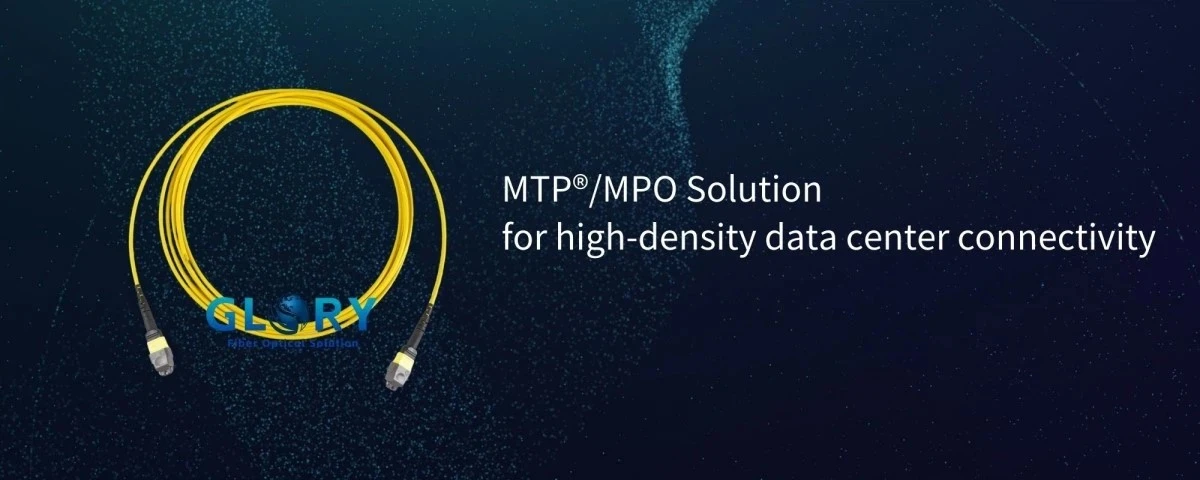
The Engine of Density and Speed: Why MPO is Non-Negotiable
The value proposition of MPO technology is rooted in radical efficiency.
• Space and Density Multiplier: A single MPO connector (with a footprint as small as 0.7" x 0.4") can consolidate 12, 24, or even 48 fibers. This replaces up to 24 separate LC duplex connections, clearing critical rack unit space for active equipment, improving airflow, and simplifying pathway management. The result is a dramatically cleaner infrastructure that reduces cooling costs and minimizes the risk of accidental service disruption during moves, adds, or changes.
• The Enabler of Parallel Optics: High-speed standards like 40G SR4, 100G SR4, and 400G SR8 rely on parallel optics-transmitting multiple data streams simultaneously over multiple fibers. The MPO interface is the native, standardized physical layer for these technologies. Deploying an MPO-structured cabling plant is therefore not an option but a prerequisite for migrating to and beyond 100G.
• Guaranteed Performance from the Factory: Unlike field splicing, Glory's MPO assemblies are pre-terminated and tested under controlled ISO 9001 factory conditions. This guarantees consistent, low insertion loss and high return loss across every fiber, eliminating a major variable in link budget calculations and ensuring network performance starts strong and stays reliable.
Glory Integration Point: Our portfolio is built for this foundational role. From high-density MTP/MPO trunk cables for spine-leaf backbone connections to breakout harnesses for top-of-rack switching, we provide the certified, reliable physical layer that high-speed networks are built upon.
The Architect's Guide: Navigating MPO Selection and Configuration
Choosing the right MPO component is a critical design decision. Here is a structured framework to ensure optimal selection.
Step 1: Define the Physical Architecture – Choose Your Cable Type
|
Cable Type |
Connector Ends |
Primary Use Case |
Ideal For |
|
MPO Trunk Cable |
MPO to MPO |
Creating structured backbone pathways between panels or modules. |
Interconnecting distribution panels in MDA, IDA, or HDA zones. |
|
MPO Breakout/Harness |
MPO to LC/SC |
Connecting high-density MPO ports to standard equipment ports. |
"Fanning out" a switch's MPO port to multiple server SFP+ or QSFP ports. |
|
MPO Conversion Cable |
MPO to MPO (different fiber counts/configurations) |
Adapting between different MPO structures without rewiring. |
Connecting a 24-fiber trunk to two 12-fiber switch ports or reconfiguring polarity. |
Step 2: Master the Critical Parameters
• Polarity (The Most Common Pitfall): Ensuring transmit ports connect to receive ports across a parallel optic link is managed by polarity. The three main methods (TIA-568-approved) must be followed systematically. Glory provides clear labeling and guidance for Type A, B, and C schemes to ensure error-free links.
• Fiber Mode & Polish: Multimode (OM3/OM4/OM5, beige/orange/aqua) with UPC polish is standard for intra-data center short-reach applications. Singlemode (OS2, yellow) with angled APC polish is for long-distance, high-performance backbones. Selecting the wrong type guarantees failure.
• Connector Gender (Key-up/Key-down) and Key Alignment: Proper alignment is crucial for mating. Our assemblies are clearly specified to ensure compatibility between cables, adapters, and equipment.
Step 3: Plan for the Specific Application
• For 40/100G SR4 connections, 8-fiber or 12-fiber MPO trunks are standard.
• For 400G SR8/DR4 and future speeds, 16-fiber or 24-fiber MPO systems are required.
• Consider bend-insensitive fiber (BIMMF) for tight cable management and plenum or LSZH-rated jackets for compliance with local fire safety codes.
Glory Integration Point: We simplify this complexity. Our technical team helps architects navigate these choices, offering not just standard products but fully customized assemblies-in specific lengths, polarity types, fiber counts, and jacket ratings-to match exact design blueprints.
The Future-Proof Link: MPO as the Platform for Agility and Intelligence
The investment in an MPO infrastructure pays long-term dividends by enabling network agility and intelligence.
• Facilitates "Plug-and-Play" Scalability: With a structured MPO backbone in place, scaling capacity often requires only adding new trunk cables and modules, not overhauling the entire cable plant. This drastically reduces deployment time for new equipment or expansion from weeks to days.
• The Heart of Agile Connectivity: Glory's MPO conversion cables are the unsung heroes of flexibility. They allow network operators to reconfigure physical connections between different generations or brands of equipment without touching the installed backbone. This turns static cabling into a dynamic resource.
• Foundation for Intelligent Infrastructure Management (IIM): A clean, structured MPO plant is easily integrated with RFID and electronic tracking systems. Each port and cable becomes a manageable digital asset, enabling accurate documentation, remote troubleshooting, and predictive capacity planning-key components of the software-defined data center.
Building Confidence, One Connection at a Time
In conclusion, selecting an MPO system is a strategic decision that defines a data center's capacity, reliability, and adaptability for its entire lifecycle. It is the critical, often underappreciated, foundation upon which digital transformation is built.
At Glory, we provide more than premium MPO/MTP cables and assemblies. We deliver intelligent physical layer solutions backed by deep engineering expertise. Our goal is to transform the cabling infrastructure from a potential point of failure into a documented, reliable, and agile asset that empowers your network to meet tomorrow's demands.
Ready to architect a more scalable and manageable data center network?
Contact Glory's technical experts today for a personalized consultation, and let us help you design and deploy the MPO foundation that turns your network vision into a reliable, high-performance reality.