





Insertion Loss & Return Loss: A Guide and How Quality Fiber Components Minimize Them
 Nov 25, 2025|
 Introduction: The Criticality of Signal Integrity
In fiber optic communication, the goal is to transmit light signals with maximum efficiency. Two fundamental parameters that define the health and performance of any optical link are Insertion Loss (IL) and Return Loss (RL). While these concepts are technical, their impact is practical: high IL can shorten transmission distances, and poor RL can destabilize lasers and degrade signal quality. This article explains these metrics and underscores how choosing reliable passive components from experienced manufacturers like GLORY Fiber Optic is crucial for minimizing them.
Understanding the Basics: IL and RL Explained
A simple analogy is water flowing through a pipe:
Insertion Loss (IL) is like water pressure dropping due to pipe friction. It measures the total signal power lost as it passes through a component like a connector, splice, or splitter.
Formula: IL (dB) = -10 * log₁₀(P_out / P_in)
Desired Value: Smaller is better. Lower IL means less signal attenuation. For example, a connector with 0.3 dB IL is superior to one with 0.5 dB IL.
Return Loss (RL) is like water being reflected back due to a sudden pipe diameter change. It measures the signal power reflected back toward the source due to impedance mismatches at a connection point.
Formula: RL (dB) = -10 * log₁₀(P_reflected / P_incident)
Desired Value: Larger is better. Higher RL indicates less reflection, meaning better connections and system stability. A value of 50 dB is significantly better than 25 dB.
|
Characteristic |
Insertion Loss (IL) |
Return Loss (RL) |
|---|---|---|
|
What it Measures |
Total signal attenuation through a device |
Signal energy reflected back to the source |
|
Impact |
Limits reach and reduces signal strength |
Can cause source laser instability and noise |
|
Primary Goal |
Minimize attenuation (Lower IL) |
Maximize reflection suppression (Higher RL) |
Common Causes of Poor IL and RL in Networks
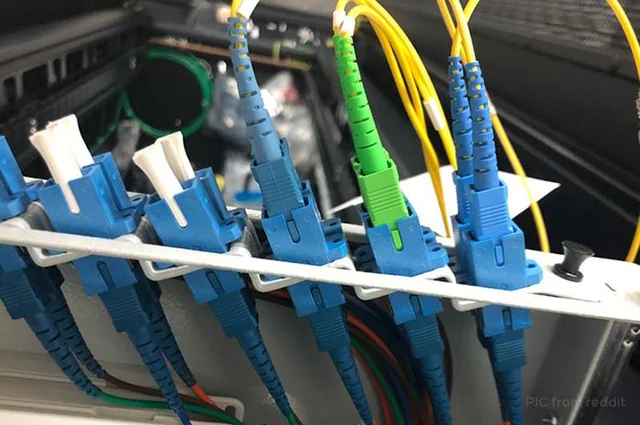
Understanding what causes loss is the first step toward prevention. Key factors include:
Poor Connector Mating: As highlighted in the technical note, forcing incompatible connectors (e.g., APC vs. PC/UPC) causes massive loss due to air gaps and design conflicts.
Substandard Connector Quality: Inconsistent ferrule geometry, poor surface polish, and improper axial alignment in low-quality connectors directly contribute to high IL and RL.
Contamination: Dust, oil, and scratches on fiber end-faces are among the most common causes of signal loss. A single dust particle can block a significant portion of the light core.
Improper Installation: Excessive fiber bending, especially beyond the minimum bend radius, causes light to escape, leading to high bending loss (a form of IL). Poor splicing techniques also introduce loss.
How Quality Components from GLORY Help Minimize Loss
The performance of your entire network relies on the quality of its smallest parts. This is where partnering with a reputable manufacturer like GLORY Optical Communication Co., Limited makes a critical difference. With over 15 years of experience in passive component manufacturing, GLORY designs its products to excel in real-world applications.
Here's how their product range addresses the challenges of IL and RL:
Precision Connectivity Solutions: GLORY's range of Fiber Patch Cords and adapter panels feature high-precision ceramic ferrules. These connectors undergo rigorous polishing (for UPC types) or precise angling (for APC types) to ensure optimal physical contact, thereby minimizing both Insertion and Return Loss. Using the correct, high-quality connector type is the simplest way to avoid the severe losses associated with mismatched connections.
Superior Protection with Splice Closures and Termination Boxes: A connection is only as good as its protection. GLORY's Dome Fiber Optic Splice Closures and Fiber Optic Termination Boxes provide a secure, sealed environment for splices and connections. They are engineered to:
1.Maintain Proper Fiber Bend Radius: Internal spools and routing guides prevent sharp bends that cause excess loss.
2.Protect Against Contaminants: High IP ratings ensure that moisture and dust cannot degrade the connections inside, preserving signal integrity over time.
3.Provide Robust Organization: Well-designed enclosures like their FTTH Distribution Enclosures prevent fiber strain and micro-bends during installation and maintenance, which are common hidden causes of IL.
4.Commitment to Quality Assurance: GLORY's emphasis on strict quality control means that every batch of products, from a simple adapter to a complex termination box, is tested to meet performance specifications. This consistency is vital for network planners who cannot afford the variability and high failure rates associated with inferior components.
Best Practices for Optimal Network Performance
Combining quality components with proper installation practices is key:
Specify the Right Connector: Use APC connectors for applications requiring minimal reflection (e.g., RF video signals, PON networks). Use UPC connectors for general data transmission where low IL is the priority. Never mix APC and UPC.
Prioritize End-Face Cleanliness: Always inspect and clean every fiber end-face with professional tools before making a connection. This is the most cost-effective way to reduce loss.
Choose a Reliable Supplier: Partner with established manufacturers like GLORY who offer comprehensive solutions-from splice closures and termination boxes to patch cords and PLC splitters. This ensures compatibility and consistent performance across your network.
Train Installers Properly: Ensure installation teams understand the importance of handling fibers gently and adhering to bend radius specifications.
Invest in Quality for Lower Loss
Insertion Loss and Return Loss are not just abstract metrics; they are direct reflections of your network's quality and health. By understanding their causes and investing in high-quality, reliable passive components from experienced manufacturers, you can build faster, more stable, and more future-proof fiber optic networks.
Explore GLORY's full range of fiber optic solutions designed for low loss and high reliability. Visit their product page here: GLORY Fiber Optic Products.