





Guardians of the Network: How Horizontal and Vertical Closures Defend Against Environmental Threats
 Feb 28, 2026|
 Author: Mia Zheng sales02@gloryoptic.com
In the world of outside plant (OSP) fiber networks, the environment is the enemy. Moisture, dust, temperature extremes, physical stress, and wind work relentlessly to undermine the integrity of every fiber splice point. The closure you choose is not just a container-it is the primary defense system for your network's most vulnerable junctions.
Two dominant designs have evolved to meet these environmental challenges: Horizontal (Inline) Closures and Vertical (Dome) Closures. Each employs a distinct engineering philosophy to protect the delicate fibers within. Understanding how they fight different battles is key to selecting the right guardian for your network.
The Universal Threats: What Every Outdoor Closure Must Face
Before diving into design differences, it's essential to understand the common enemies:
• Moisture Ingress: The #1 killer of fiber performance. Water causes hydrogen absorption (signal loss) and, when frozen, can physically crush fibers.
• Dust and Contaminants: Particulates can scratch connector end-faces or compromise seals over time.
• Mechanical Stress: Soil pressure in buried applications, wind vibration in aerial mounts, and accidental impacts all test structural integrity.
• Temperature Cycling: Repeated expansion and contraction can loosen seals and stress fiber joints.
• UV Radiation: Constant sun exposure degrades materials, leading to cracking and embrittlement.
Now, let's examine how each design philosophy wages war on these threats.
The Horizontal (Inline) Closure: The Versatile All-Rounder
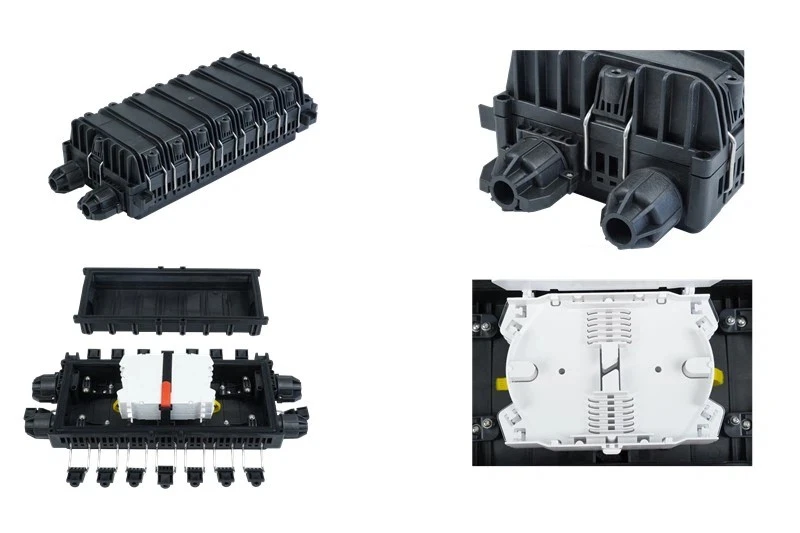
Horizontal closures, with their flat or cylindrical profile, are designed for maximum deployment flexibility without compromising protection.
Environmental Defense Strategy:
• Multi-Point Sealing: Most horizontal closures employ compression gaskets or gel-based sealing systems at the base and along cable entry ports. This creates a robust barrier against moisture and dust across multiple potential entry points.
• Re-enterable Design: A key feature for longevity is the ability to re-open and reseal without destroying the seal. High-quality horizontal closures use mechanical latches or clamps that allow technicians to access the interior for maintenance or upgrades, then re-establish the same level of protection-critical for long-term network evolution.
• Compression Resistance: When buried or placed in ducts, these closures face constant external pressure. Their engineering-grade plastic shells (often polypropylene or ABS) are formulated to resist deformation, protecting internal splice trays from crushing forces.
• Secure Mounting Engineering: For aerial applications, the closure's mounting brackets and tie-down points are not an afterthought. They are designed to grip the cable firmly, transferring the load of wind and ice away from the internal splices and onto the strength members. A closure that swings or twists in the wind will eventually fatigue the fibers inside.
Ideal Deployment:
• Mixed aerial/underground routes requiring one closure type for simplicity.
• High-capacity backbone splicing (hundreds of fibers).
• Locations where future re-entry for network expansion is anticipated.
The Vertical (Dome) Closure: The Specialist for Extreme Conditions
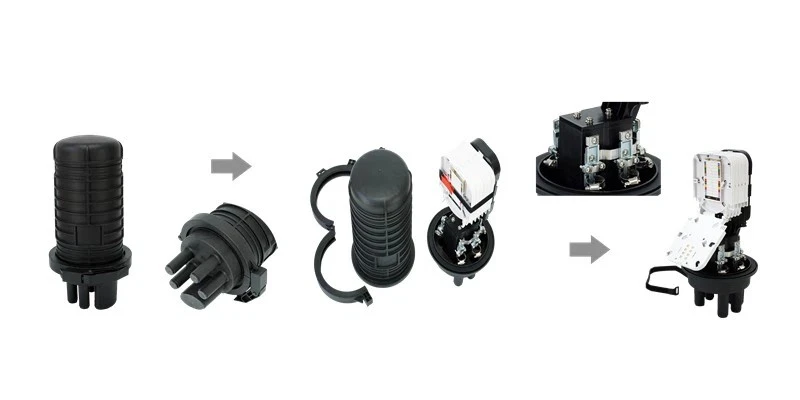
Vertical, or dome-style closures, are purpose-built for environments where sealing against pressure and moisture is the absolute priority.
Environmental Defense Strategy:
• The Dome Advantage: The cylindrical, domed shape is inherently strong. It evenly distributes external pressure from soil, water, or ice, much like an arch in architecture. This makes dome closures the preferred choice for direct burial in high-water-table areas.
• Superior Seal Technology: In vertical designs, the seal is the hero. These closures typically use a high-grade rubber gasket compressed between the dome and the base plate. When combined with heat-shrinkable or gel-sealed cable entry ports, they achieve the industry's highest ingress protection ratings-IP68 is the standard, not the exception.
• Gravity-Assisted Drainage: The dome shape naturally sheds water. Rain, snow, or condensation runs off rather than pooling on top, reducing the long-term risk of water ingress through the sealing interface.
• Configurable Ports for Flexibility: While the dome itself is fixed, modern vertical closures offer modular base plates with multiple, customizable cable entry ports (round, oval, or pre-terminated). This allows technicians to adapt the closure to different cable diameters and counts without compromising the primary seal.
Ideal Deployment:
• Direct burial in flood-prone or high-moisture environments.
• Manhole installations where standing water is common.
• Pole-mounted in areas with extreme weather (heavy rain, snow load).
• Applications where long-term, "fit and forget" reliability is mandated.
No Single Champion, Only the Right Tool
There is no "best" closure design-only the best design for your specific environmental battlefield.
The horizontal closure is the versatile generalist, ready to perform reliably across aerial, duct, and buried applications while offering excellent capacity and ease of maintenance. It is the workhorse of the outside plant.
The vertical closure is the specialist, engineered to win wars against water and pressure in the most demanding buried and flood-prone environments. It offers peace of mind where conditions are at their worst.
For network planners and engineers, the path to reliability is clear: assess your environmental threats honestly, and then arm your network with the closure design engineered to defeat them. Both horizontal and vertical closures, when built to high standards, will guard your network. But only one is the perfect guardian for your specific corner of the outside plant.
Equip Your Network with the Right Guardian: At Glory, we engineer both horizontal and vertical splice closures to meet the highest standards of environmental protection. Whether you need the versatility of an inline closure or the extreme sealing of a dome design, we have a solution built to defend your network. Contact our team to discuss your specific deployment challenges and find the perfect match.