





Fiber Optic Terminal Box: The Terminus and Starter of the Fiber Network
 Dec 19, 2025|
End Point: The Secure "Destination" of Outdoor Fiber Optic Cables
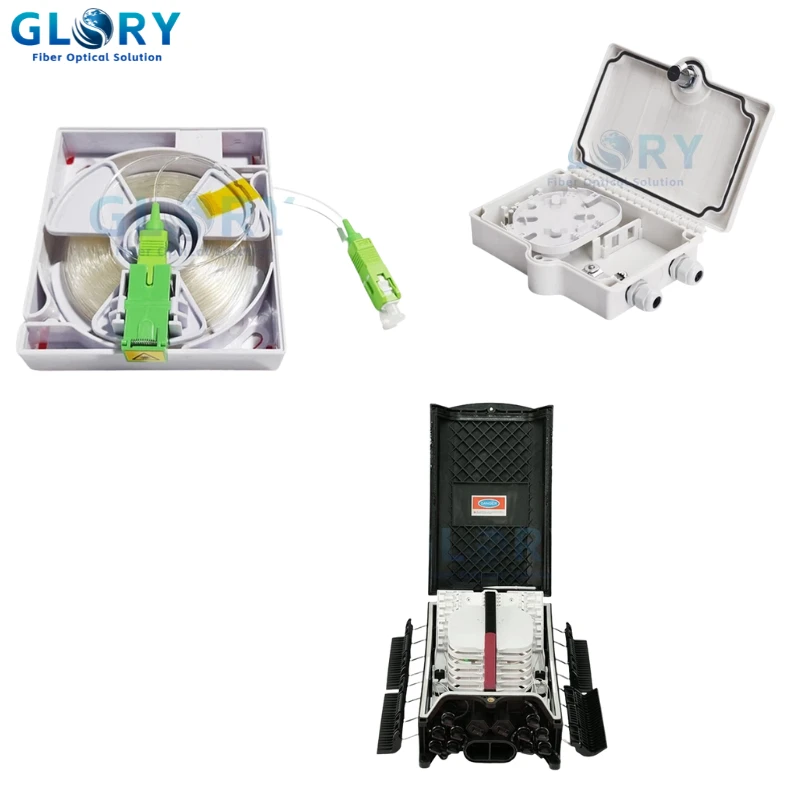
When outdoor fiber optic cables carrying massive amounts of data (whether buried, overhead, or installed in conduits) reach their destination-a data center, base station, or building entrance-their journey reaches a critical juncture. At this point, the fiber optic cable needs:
1. Secure Mechanical Termination
First, the terminal box provides a robust anchor point for the "body" of the fiber optic cable. Through precise cable fixing and grounding components, it absorbs tensile stress on the cable, reduces stress on the internal optical fibers, and provides reliable electrical grounding protection against surges such as lightning strikes.
2. Precise Fiber "Release" and Protection
Inside the enclosure, the cable sheaths and armor are stripped, and the fragile optical fibers are carefully released. These fibers are then guided to the splice tray-the true heart of the terminal box. Here, the fibers from the outdoor cables are fused (either fusion splicing or mechanical connection) to pigtails with connectors (such as LC or SC). The splice tray provides perfect protection: it secures each splice point, provides orderly storage for excess fiber (preventing excessive bending), and clearly labels all fibers for easy future maintenance.
Initiator: A Convenient Gateway to the Patch Cord World
After termination, the terminal box seamlessly transitions from a "terminator" to an "initiator." Connectors at the other end of the pigtails insert into the adapter panel at the front of the cabinet. These adapter ports become neat, standardized physical interfaces for patch cord connections within the equipment room.
This conversion offers three key advantages:
Boundary Point: The terminal box clearly defines the boundary between "external fixed cables" and "internal removable patch cords," serving as a standard node for network management, responsibility allocation, and performance testing (e.g., using an Optical Time Domain Reflectometer (OTDR)).
Flexibility:Front-panel patch cords allow for easy connection to optical switches, test equipment, or other patch panels without touching the protected permanent fusion splices at the rear.
Reliability: All sensitive permanent fusion splices are sealed and protected within the cabinet, completely isolated from frequent plugging and unplugging operations, significantly improving the long-term stability of the network.
Fundamental Difference from Fiber Optic Distribution Box:Terminal boxes are often confused with Fiber Optic Distribution Box. The key is understanding their core functional differences:
Fiber Optic Terminal Box:One-to-one or low-density conversion. Typically, one fiber from the input cable corresponds to one or several output ports. Its core function is termination and interface conversion.
Fiber Optic Distribution Box:One-to-many splitting. One or several input fibers are split into dozens of output ports via an internal optical splitter. Its core function is optical power distribution.
In short, the terminal box is the "gateway," while the distribution box is the "splitter."
Selection Considerations: Focus on Reliability
A high-quality terminal box should possess the following characteristics:
Rugged Construction: Utilizing high-grade engineering plastics or metal casings, providing sufficient physical protection and flame retardancy.
Clear Internal Layout: Logically layered splice trays, rational cable routing paths, and a comprehensive labeling system.
High-Quality, High-Precision Adapters: Ensuring low insertion loss and long-term reliable connection performance.
Sufficient Capacity and Scalability: Selected based on the number of fibers, considering potential future expansion needs.
Silent Hub, Critical Hub
The fiber optic terminal box is quietly installed in the equipment rack, but its value extends throughout the entire network lifecycle. It ensures absolute security at vulnerable indoor and outdoor transition points and lays the foundation for a clean, flexible, and easily managed cabling system. Choosing the right terminal box is not just about providing a "home" for the fiber optic cable, but about building a reliable and efficient operational hub for the entire fiber optic network.