





Decoding the Physical Layer: A Comprehensive Guide to Data Center Fiber Infrastructure
 Mar 06, 2026|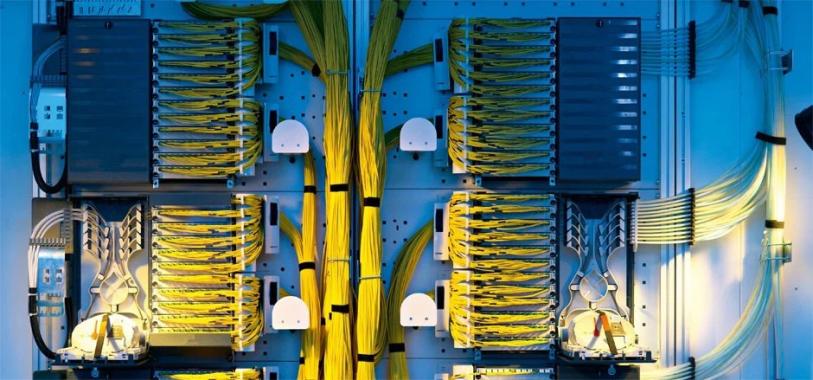
Step into any modern data center, and you're greeted by the hum of cooling fans, the blink of server lights, and the organized chaos of countless cables. But beneath this surface lies the true foundation of digital connectivity: the physical layer. This intricate web of fiber optic cabling is the circulatory system of the data center, carrying the lifeblood of information between servers, switches, storage, and the outside world.
Yet, as data rates climb from 40G to 400G and beyond, the physical layer faces unprecedented challenges-space constraints, heat dissipation, signal integrity, and the ever-present need for manageability. Understanding how to architect this layer is no longer just a wiring exercise; it's a strategic imperative.
This guide decodes the physical layer, walking you through the critical components of a modern data center's fiber infrastructure and explaining the role each plays in building a robust, scalable foundation.
Part 1: The Gateway – Where the Outside World Meets the Core
Every data center begins where external connectivity enters the building. This point, often labeled Entrance/Exit in facility diagrams, is the demarcation between the service provider's network and your own.
The Challenge:
The incoming trunk cable, often carrying hundreds of fiber strands from multiple carriers, must be securely terminated, protected, and organized for distribution inside the facility. This is a high-stakes junction-a failure here impacts everything downstream.
The Solution:
The Main ODF (Optical Distribution Frame)
The first critical component encountered is the main ODF, often a large floor-standing or wall-mounted frame. Think of it as the Grand Central Terminal of your fiber network.
What it Does: The ODF performs several essential functions in one unit:
• Termination: It provides the physical interface where incoming feeder cables are permanently terminated, often by splicing them to pigtails connected to adapter ports on the front.
• Splicing Protection: It houses and protects the delicate fusion splices where the outside cable meets the internal pigtails.
• Organization: It brings order to chaos, routing hundreds of individual fibers from the bulky external cable into neat, organized, and labeled adapter ports (typically SC, LC, or MPO).
Why Choose a High-Quality ODF Here?
• Protection: The main ODF safeguards the most vulnerable part of the network-the entry point-from physical damage, dust, and stress.
• Clarity: It creates the first clear demarcation point. Now, every fiber from the outside world has a predictable, accessible home port.
• Scalability: A modular ODF allows you to terminate only the fibers needed now, leaving capacity in the frame for future expansion without disruption.
Part 2: The Backbone – High-Speed Highways Between Zones
Once the external fibers are terminated at the main ODF, the next task is to connect them to the various distribution points across the data center-the Distribution ODFs located in different rows or zones. This requires the backbone cabling.
The Challenge:
Running individual duplex cables for hundreds of connections between distant ODFs would create an unmanageable mess and consume valuable pathway space. Furthermore, as speeds increase to 100G and 400G, the cabling itself must support parallel optics.
The Solution: MPO Trunk Cables
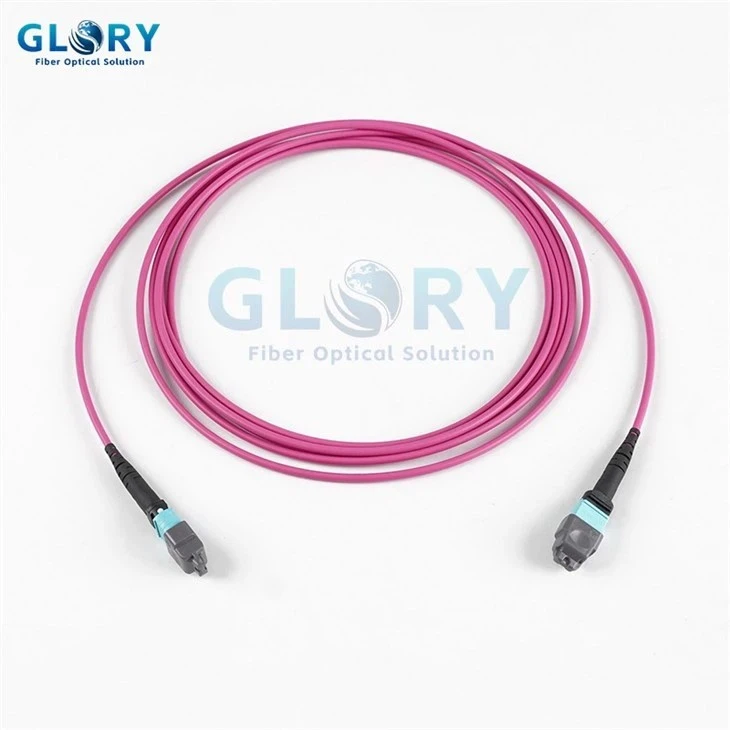
This is where MPO (Multi-fiber Push On) technology becomes indispensable. An MPO trunk cable is a high-density assembly with multiple fibers (typically 12, 24, or 48) terminated in a single, compact MPO connector at each end.
What it Does:
It acts as a high-capacity, pre-terminated highway between the main ODF and distribution ODFs, or between core and leaf switches. A single 24-fiber MPO trunk can replace 12 duplex LC cables, drastically reducing cable volume.
Why Choose MPO Trunk Cables?
• Space Savings: Dramatically reduces congestion in cable trays and under-floor pathways, improving airflow and simplifying management.
• Speed of Deployment: Factory pre-terminated and tested, these cables install in minutes compared to the hours or days required to run and terminate individual fibers.
• Supports High Speeds: Essential for 40G, 100G, and 400G architectures that rely on parallel optics (e.g., 40G-SR4 uses 8 fibers, 100G-SR4 uses 8 fibers, 400G-SR8 uses 16 fibers).
• Polarity Management: High-quality MPO trunks are manufactured with specific polarity methods (Type A, B, or C) to ensure that transmit signals correctly align with receive ports across the entire link, eliminating a common source of error.
GLORY's MPO trunk cables are available in a wide range of fiber counts (8F to 144F), modes (OM3/OM4/OM5), and polarity types, rigorously tested to ensure optimal performance for your backbone links.
Part 3: The Distribution Hub – The Nerve Center of Each Zone
At the end of each MPO trunk lies the Distribution ODF. This is the local nerve center for a specific row, aisle, or zone of cabinets. It's where the high-capacity backbone is broken down into individual connections for servers and switches.
The Challenge:
The Distribution ODF must be incredibly flexible. It receives high-density MPO connections from the core but needs to provide standard duplex LC interfaces to the vast majority of servers and switches. It must also facilitate quick moves, adds, and changes (MACs) without disrupting live traffic.
The Solution: Modular, High-Density Distribution ODFs
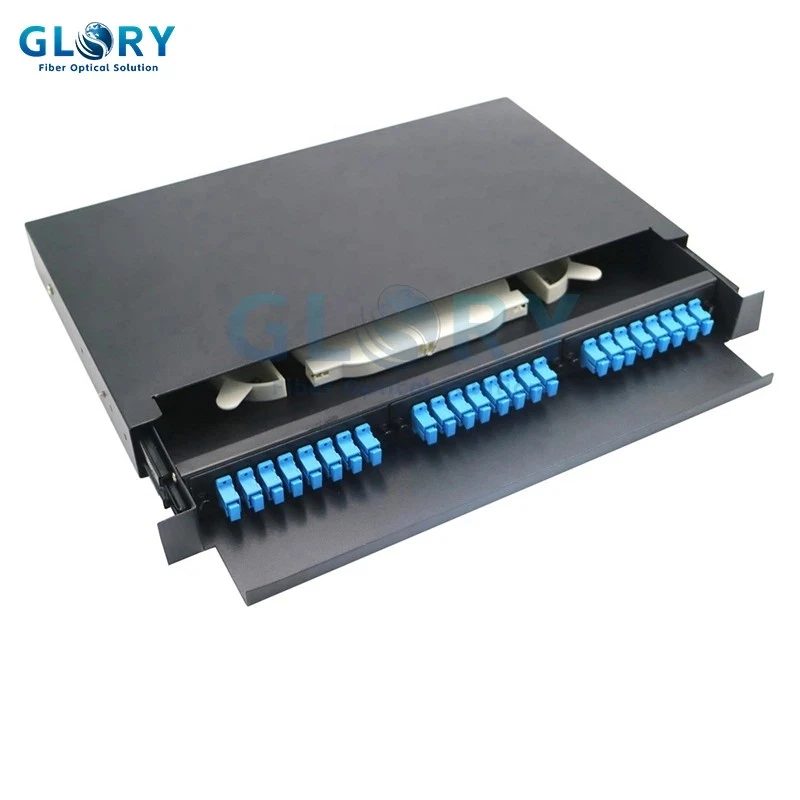
A Distribution ODF is not a one-size-fits-all box. It's a platform designed for adaptability.
What it Does:
• Terminates Backbone Cables: It provides the patch panels where the MPO trunks from the core are terminated, typically using MPO cassettes or adapter panels.
• Provides Device Connectivity: It offers a dense array of LC duplex ports (or other connector types) ready for patching to servers and top-of-rack (TOR) switches.
• Manages Cross-Connects: It serves as the central patching field, allowing technicians to use short jumper cables to connect any backbone port to any device port with complete flexibility.
Why Choose a Modular Design?
• Flexibility: Modular panels or cassettes allow you to mix and match connector types. A single Distribution ODF can house MPO cassettes for backbone connections alongside LC duplex panels for server connections.
• Manageability: Features like sliding drawers, front and rear cable management, and clear labeling are non-negotiable. They allow technicians to work efficiently without disturbing adjacent connections.
• Scalability: As your zone grows, you simply add more modules to the frame. This pay-as-you-grow model optimizes capital expenditure.
GLORY's rack-mount ODFs are designed with these principles, offering tool-less access, integrated spooling for slack storage, and a full range of modular panels to support any connector type.
Part 4: The Final Mile – Connecting to Servers and Switches
The last leg of the journey is the connection from the Distribution ODF to the actual active equipment: the Network Switches and servers. This final mile requires two primary types of fiber assemblies.
The Challenge:
Connecting a high-density patching field (often with LC duplex ports) to switch ports that may be either LC or MPO, and doing so in a way that maintains signal integrity and allows for easy future changes.
The Solutions:
MPO Breakout Cables & Standard Fiber Patch Cords
A. MPO Breakout Cables (Harness Cables)
• What They Are: These specialized assemblies have a single MPO connector on one end and multiple duplex connectors (typically 4, 6, or 12 LC) on the other.
• Where They're Used: They are the perfect tool for connecting a high-density MPO switch port to multiple server ports or to a patch panel. For example, a 40G switch port (using an MPO connector) can connect to a breakout cable that fans out into four 10G LC connections for four separate servers.
• Why Choose Them: They provide a factory-engineered, reliable transition between MPO-based high-speed equipment and the standard LC-based structured cabling infrastructure. They eliminate the need for separate MPO-to-LC fan-out modules and additional patch cords.
B. Standard Fiber Patch Cords (Duplex LC, SC, etc.)
What They Are: The most common and familiar component-a simple, duplex fiber jumper with LC, SC, or other connectors on each end.
Where They're Used: For direct connections between a Distribution ODF port and a server NIC, or between a patch panel and a TOR switch's fixed LC port. They are also used for short, direct links within a rack.
Why Choose Quality Patch Cords:
Performance here is critical. A poor-quality patch cord with high insertion loss or poor return loss can degrade the entire link. Look for cords with reliable connectors, durable strain relief boots, and the correct fiber mode (OM3/OM4 for multimode, OS2 for singlemode).
GLORY offers a comprehensive range of both MPO breakout cables and standard patch cords, available in various lengths, connector types, and fiber modes, all rigorously tested to ensure end-to-end signal integrity.
Building a Foundation for the Future
A data center's physical layer is far more than just "cabling." It is a carefully engineered system of interconnected components, each playing a vital role in ensuring performance, reliability, and manageability.
From the Main ODF at the entrance, through the MPO Trunk highways, to the flexible Distribution ODFs, and finally the breakout cables and patch cords that touch the servers, every element must be chosen with care. Investing in high-quality, standards-based components-and understanding how they work together-is not an expense; it is a strategic investment in the data center's long-term operational efficiency, scalability, and total cost of ownership.
When these components are designed and deployed as an integrated system, the result is a physical layer that is not just a passive support structure, but an active enabler of business agility and growth.