





30 Kilometer Long-Range Reconnaissance: How the FPV drone fiber optic Becomes the Invisible Umbilical Cord for Border Patrol Drones?
 Mar 05, 2026|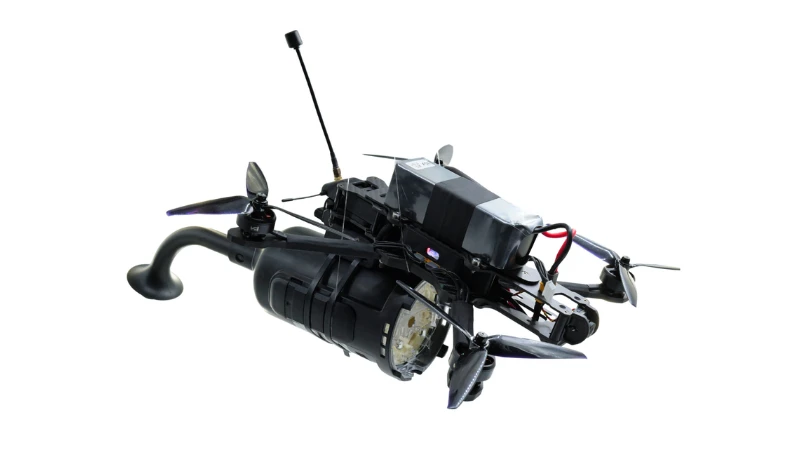
Along the border stretching thousands of kilometers, from high-altitude mountains to barren deserts, from dense forests to disputed areas, the biggest challenge for patrol personnel is always: how to achieve continuous, all-weather, and comprehensive surveillance? Traditional drones, limited by battery life and wireless signal transmission, are often ill-suited for this task. However, FPV drone fiber optic-is changing this situation.
Breaking Wireless Limits: The Strategic Value Behind 30 Kilometers
Border patrol missions differ fundamentally from urban operations. They often require penetration into uninhabited areas and navigation across complex terrain. Traditional drone wireless video transmission, limited by line-of-sight and terrain obstruction, typically experiences signal degradation or even loss within 10-20 kilometers. The FPV drone fiber optic supports customizable lengths from 3 to 30 kilometers, meaning drones can penetrate 30 kilometers deep into border territory for reconnaissance while command centers still receive real-time high-definition footage.
This 30-kilometer capability isn't just a number. In border scenarios, it translates to:
1.A single outpost drone covering areas that would otherwise require a full day of foot patrol
2.Illegal crossings behind mountain ridges no longer becoming monitoring blind spots due to "terrain obstruction"
3.Reconnaissance aircraft observing suspicious targets from safe distances without alerting them
According to operational data from border defense units, drones equipped with fiber optic systems reduce border monitoring blind spots by over 83%.
Bend-Insensitive Fiber + Magnetic Levitation Tension: A "Steel Nerve" in Complex Terrain
Border terrain is rarely forgiving. Drones often must navigate through valleys and hover above dense forests. This imposes strict demands on the fiber optic: It must be thin and lightweight, yet withstand repeated bending while maintaining stable deployment during maneuvering flight.
The FPV drone fiber optic utilizes G657A2 bend-insensitive optical fiber (diameter only 0.27-0.4mm), which maintains signal attenuation at extremely low levels even when bent at 90-degree angles. This means communication links remain stable as drones traverse tree canopies or fly close to the ground.
Even more critical is its magnetic levitation tension control system. When drones maneuver in border-area gale-force winds (Level 6 or stronger), traditional mechanical tension often cause cable rebound and entanglement due to inertia. Magnetic levitation technology achieves precise deployment/retrieval speed control from 0.05 to 2m/s, with rebound rate below 0.7% during emergency stops-virtually eliminating the risk of tangled mechanisms lines. Pilots can focus on reconnaissance missions rather than worrying about cable management.
ABS Engineering Plastic: All-Weather Environmental Reliability
Border environments are never mild: scorching days, freezing nights, alternating wind, sand, and salt fog. The spool itself must be exceptionally robust.
The FPV drone fiber optic features black ABS engineering plastic (density 1.15-1.2g/cm³), combining high strength with lightweight properties. It holds UL94 HB flame retardant certification and operates across a wide temperature range of -30°C to 75°C. Whether deployed in extreme cold outposts or blazing gobi deserts, the spool functions reliably without material embrittlement or deformation causing cable jams.
Additionally, its modular interface design supports standard connectors including FC, ST, SC, and LC. Border defense units can quickly integrate the system without modifying existing equipment, significantly reducing deployment barriers.
Battlefield Validation: Anti-Interference Is the True Advantage
Recent regional conflicts have validated the tactical value of fiber optic drones. Because they transmit signals through physical fiber optic cables, they are completely immune to electronic warfare interference-no GPS signal loss, no control link hijacking. International operational data shows fiber optic drones can survive nearly 12 hours in intense electromagnetic interference environments, far surpassing conventional drones.
For border patrol missions, this means: adversaries cannot "blind" or "hijack" your drone through electronic attack. Signals transmit through closed optical fiber, impossible to intercept or jam-this "invisible umbilical cord" keeps drones continuously connected to command centers.
Conclusion
From 30-kilometer extended range to magnetic levitation precision control, from wide-temperature reliability to battlefield-proven anti-interference capability-FPV drone fiber optic is redefining the operational radius and mission reliability of border patrol drones. It may be just one component on the drone, but it's the invisible umbilical cord that ensures your drone never loses connection.