





Beyond Concrete and Cast Iron: How SMC/F46 Composite Materials Are Redefining the Century-Old Standard for Underground Manholes
 Feb 17, 2026|
 Author:Willa Shang willa@gloryoptic.com
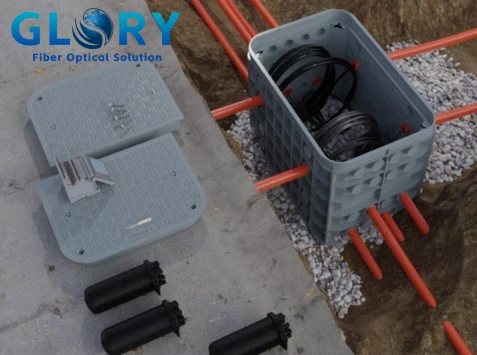
Every time a city road is "torn open" again for utility maintenance, we witness not just traffic congestion, but also the exposure of the fragility and short-sightedness of traditional underground infrastructure. Concrete and cast iron, the century-old materials for constructing underground manholes and handholes, with their inherent cracking, corrosion, leakage, and bulkiness, are increasingly becoming heavy shackles on the agile deployment and reliable operation of smart cities. Today, a silent material revolution is happening underground-a new generation of intelligent inspection chambers, crafted from aviation-grade SMC/F46 composite materials, is redefining the standards for underground nodal infrastructure.
The "Triple Bind" of Traditional Materials
To assess this revolution, we must first understand the century-old challenges of concrete and cast iron:
The Scourge of Chemical Corrosion: Acids, alkalis, stray currents in the soil, and winter de-icing salts continuously erode concrete and cast iron, leading to structural spalling and rapid strength loss. Theft of cast iron manhole covers remains a global headache.
The Pain of Physical Failure: Concrete is prone to cracking. Groundwater carrying silt seeps in, clogging conduits and soaking cables. The immense stress from seasonal frost heave and ground settlement often joint causes misalignment and seal failure.
The Dilemma of Maintenance and the Future: Installing multi-ton components relies on heavy machinery and long construction windows. Their enclosed "black box" nature makes internal conditions unknowable, forcing maintenance into a completely reactive, periodic lid-opening inspection mode-costly and inefficient.
SMC/F46 Composite Material: The "Ultimate Answer" from Aerospace Technology
To solve these problems fundamentally, we introduce a material not originally intended for the ground-aviation-grade perfluoroethylenepropylene (F46) composite material-formed using Sheet Molding Compound (SMC) technology. This is not merely a material swap; it is a dimensional upgrade in system performance:
Ultimate Chemical Inertia: F46, known as the "Plastic King," boasts corrosion resistance threefold that of conventional PVC, virtually shrugging off all acids, alkalis, salts, and organic solvents. This means it can achieve over 50 years of zero-corrosion service in the complex underground chemical environment, far outlasting traditional materials.
Exceptional Physical Tolerance:
Temperature: Withstands a range from -200°C to +200°C, making it impervious to extreme temperature swings from permafrost to desert surfaces, with no degradation in physical properties.
Strength and Flame Retardancy: Meets the highest UL94 V-0 flame retardancy standard, preventing flame spread. Its composite structure delivers high strength and toughness, effectively resisting surface loads and settling stress.
Revolutionary Lightweighting and Sealing: Weighing only a fraction of concrete or cast iron, it can be carried and installed by two people, drastically reducing labor intensity and risk. Combined with precision molds and patented sealing design, it easily achieves the highest IP68 waterproof and dustproof rating, ensuring "zero leakage" even under 2,000N axial tensile force-creating a dry, clean "safe deposit box" for underground fiber cables.
The Value Leap: From "Cost Center" to "Intelligent Asset"
The new material brings more than just improved physical properties; it enables a fundamental revaluation of underground facilities:
Victory in Total Cost of Ownership (TCO): While the initial investment might be higher, calculated over a 10-20 year lifecycle: near-zero maintenance cost, zero corrosion replacement, significantly lower installation and operational costs, and the elimination of service interruption losses caused by water ingress failures-its TCO is far lower than traditional solutions requiring repeated upkeep and premature replacement.
The Natural Platform for Smart Integration: The sturdy, sealed, and stable composite chamber is the ideal platform for deploying fiber optic sensing and intelligent monitoring systems. Our GL46 inspection chamber can be pre-embedded with a distributed fiber optic sensing network, detecting strain and vibration in real-time with ±0.1με precision. Coupled with AI algorithms, it enables millimeter-level early warning for geological subsidence and unauthorized excavation, shifting maintenance from "reactive repair" to "proactive prediction."
Choose the Future, Don't Patch the Past
The city's underworld should not be synonymous with fragility and chaos. Choosing an SMC/F46 composite intelligent inspection chamber is not a simple product upgrade; it is a shift in infrastructure philosophy: from selecting consumable construction materials to investing in permanent intelligent assets;from accepting periodic failure and excavation to embracing predictable stability and tranquility.
It means that what we lay for the next-generation city is no longer a "vascular system" requiring constant repair, but an "intelligent neural network" capable of self-sensing, lifelong reliability, and silent service. This is the new starting point, beyond the century-old standard.