





Single-Mode vs. Multimode Fiber: Selecting the Optimal Choice for Your Network
 Nov 18, 2025|
 As a leading producer of fiber optic splice closures, distribution enclosures, and terminal devices, GLORY ensures our products are compatible with both fiber varieties, delivering dependable operation across all installations.
Core Difference: Light Propagation Method
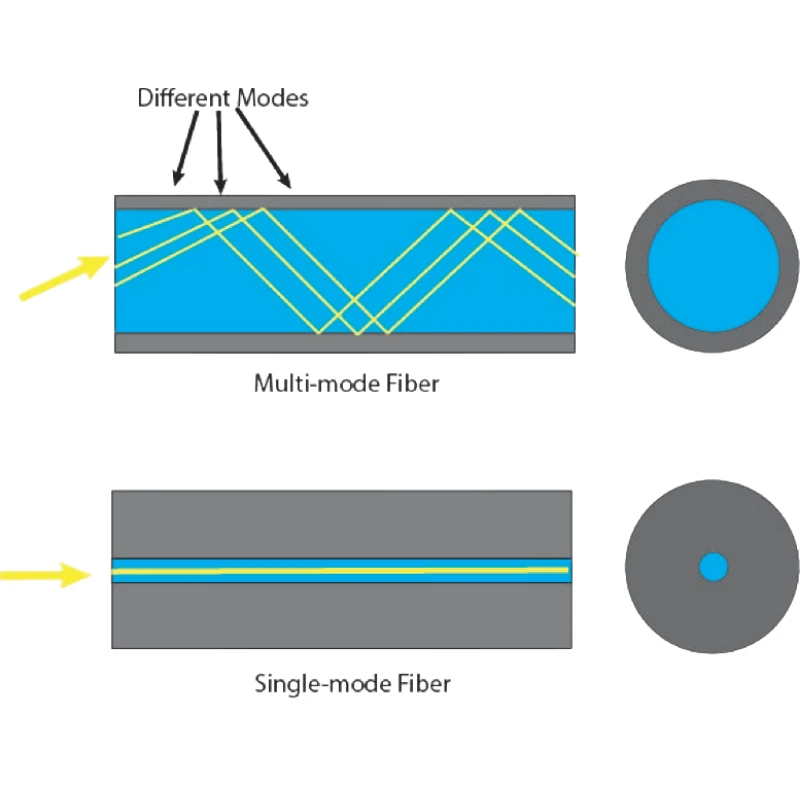
•Single-Mode Fiber (SMF) has an exceptionally thin core (around 8–10 micrometers). It carries light in a single, direct path with minimal reflections, reducing signal loss and distortion. This makes it highly effective for long-distance communication.
•Multimode Fiber (MMF) has a wider core (50 µm or 62.5 µm), enabling multiple light paths (modes) to transmit simultaneously. However, these varying paths cause modal dispersion, where signals arrive at slightly different times, restricting its bandwidth and maximum range.
Key Comparisons
1. Transmission Range & Data Capacity
The most critical difference is how far each fiber type can maintain reliable data transfer.
•Single-Mode Fiber is ideal for long-distance applications, supporting high bandwidth over distances ranging from several kilometers to hundreds of kilometers with negligible signal weakening. It is commonly used in:
•Telecom backbone systems
•Fiber-to-the-Home (FTTH) networks
•Metropolitan area networks (MANs)
•Inter-building connections across campuses
•Multimode Fiber is best for short-distance needs (up to ~550 meters). While enhanced versions like OM4 and OM5 can manage 100GbE speeds over 150 meters, performance declines over longer spans. It is typically deployed in:
•Data centers (server-to-switch links)
•Corporate Local Area Networks (LANs)
•Building-scale networks
2. Cost Factors
•Single-Mode Fiber has cheaper cable costs but necessitates high-priced laser transceivers, raising the initial setup cost.
•Multimode Fiber has pricier cables (due to its broader core) but works with more economical LED or VCSEL transceivers, which also use less energy.
3. Recommended Applications
•You require long-distance transmission (exceeding 500–600 meters).
•You're involved in ISP infrastructure, FTTH, or MAN projects.
•Future scalability and maximum bandwidth are essential.
•Your network operates within a single structure or data center.
•Your connections are under 550 meters.
•You aim to reduce costs for short-range links.
GLORY's Solutions for All Fiber Types
•Fiber Optic Splice Closures – Safeguard fused connections in outdoor and aerial setups.
•Fiber Termination Boxes & Rosette Boxes – Provide structured, easy-access connections in buildings or customer sites.
•Fiber Terminals (FATs/MSTs) – Facilitate efficient signal distribution in FTTH networks, leveraging SMF's long-distance capabilities.
Final Recommendation: No Universal Best Option
•Single-Mode Fiber is the superior option for long-range, high-capacity networks.
•Multimode Fiber remains the most economical solution for short-distance, high-speed applications.