





OM5 Fiber: A Comprehensive Review from the Latest Multimode Perspective
 Dec 04, 2025|
 1 Introduction to OM5 Fiber: The New Generation of Multimode Fiber
OM5 fiber, officially designated as Wideband Multimode Fiber (WBMMF), represents the most significant advancement in multimode fiber technology since the introduction of OM4. Ratified as a standard in 2016 by TIA and ISO/IEC, OM5 was specifically engineered to address the escalating bandwidth demands of modern data centers, enterprise networks, and high-performance computing environments. Unlike its predecessors that were optimized primarily for 850nm operation, OM5 extends the operational wavelength range from 850nm to 953nm, enabling revolutionary transmission techniques that dramatically increase data capacity without requiring additional fiber infrastructure.
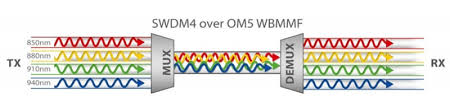
The fundamental innovation of OM5 lies in its support for Shortwave Wavelength Division Multiplexing (SWDM) technology, which allows multiple wavelengths to be transmitted simultaneously over a single fiber strand. This capability transforms the economics of high-speed data transmission by reducing fiber counts while maintaining backward compatibility with existing OM3 and OM4 systems. With its distinctive lime green jacket color (distinguishing it from OM3/OM4's aqua), OM5 provides visual identification while offering substantial technical advantages for forward-looking network architectures.
Table: Comparative Specifications of Multimode Fiber Types
|
Fiber Type |
Core Diameter |
Jacket Color |
Bandwidth (850nm) |
SWDM Support |
|---|---|---|---|---|
|
OM1 |
62.5μm |
Orange |
200 MHz·km |
No |
|
OM2 |
50μm |
Orange |
500 MHz·km |
No |
|
OM3 |
50μm |
Aqua |
2000 MHz·km |
Limited |
|
OM4 |
50μm |
Aqua |
4700 MHz·km |
Limited |
|
OM5 |
50μm |
Lime Green |
4700+ MHz·km |
Full |
2 Technical Innovations and Performance Advantages
2.1 Enhanced Bandwidth and Wavelength Range
The cornerstone of OM5's performance advantage is its extended wavelength operation from 850nm to 953nm, compared to the conventional 850nm and 1300nm windows used by previous multimode fibers. This expanded range enables OM5 to support at least four distinct wavelengths (typically 850nm, 880nm, 910nm, and 940nm) simultaneously through SWDM technology. While OM5 maintains the same 4700 MHz·km bandwidth at 850nm as OM4, its true differentiation emerges at higher wavelengths, with a specified bandwidth of 2470 MHz·km at 953nm, ensuring consistent performance across the entire operational spectrum.
This broadband capability translates directly into practical benefits for high-speed transmission. OM5 fiber can support data rates of 100G, 200G, and 400G over standardized distances, making it particularly suitable for modern data center applications. For instance, OM5 enables 100G transmission up to 150 meters using SWDM4 technology, and can extend to 440 meters for 40G applications. This represents a significant improvement over OM4's capabilities, especially for multi-wavelength applications where OM5 provides approximately 50% greater distance for the same data rate.
2.2 Fiber Reduction Through SWDM Technology
The implementation of Shortwave Wavelength Division Multiplexing (SWDM) represents a paradigm shift in multimode fiber utilization. Traditional parallel optic approaches required multiple fibers for high-speed transmission-for example, 40G networks traditionally utilized 8 fibers (4 for transmission, 4 for reception). In contrast, SWDM technology enables the same 40G throughput using only 2 fibers by multiplexing four 10G channels at different wavelengths onto each fiber.

This fiber reduction capability becomes increasingly significant at higher data rates. For 100G applications, OM5 with SWDM requires just 2 fibers compared to 8 fibers with conventional approaches. Similarly, 400G transmission can be achieved with 8 fibers instead of 16. This substantial reduction in fiber count yields multiple downstream benefits: reduced connector costs, simplified cable management, higher port density, and decreased cleaning and maintenance requirements. The cumulative effect is a significant improvement in both capital and operational expenditures for large-scale deployments.
2.3 Backward Compatibility and Migration Path
A crucial design consideration for OM5 is its complete backward compatibility with existing OM3 and OM4 fiber infrastructure. Since OM5 shares the same 50μm core diameter as OM3/OM4, it can be seamlessly integrated into established networks without requiring complete infrastructure overhaul. This compatibility provides organizations with a flexible migration path, allowing them to implement OM5 in new installations or selectively upgrade specific network segments while preserving existing investments.
This backward compatibility extends to both connectivity and operational characteristics. OM5 works with standard LC connectors and MTP interfaces commonly deployed in data centers. Additionally, OM5 supports all legacy applications running on OM3/OM4 infrastructure, ensuring uninterrupted operation during transitional phases. The combination of enhanced performance and compatibility makes OM5 an ideal solution for organizations seeking to future-proof their networks while maintaining existing operational capabilities.
3 Application Scenarios and Implementation Benefits
3.1 Data Centers and High-Speed Computing
Modern data centers represent the primary application environment for OM5 fiber, where its technical advantages translate directly into operational and economic benefits. In high-density data center architectures, OM5's ability to support higher speeds with reduced fiber count addresses critical challenges of space optimization and cable management. The implementation of MTP® OM5 cables, which can accommodate up to 288 individual fibers in a single connector, enables unprecedented port density while simplifying pathway congestion.
For high-performance computing (HPC) environments and hyperscale data centers, OM5 provides the necessary infrastructure to support emerging technologies such as 400G Ethernet. As data centers evolve toward 400G and beyond, OM5's extended reach and multi-wavelength capabilities position it as a foundational technology. The extended transmission distances (up to 150m for 100G and 440m for 40G) provide design flexibility for large-scale data center layouts, reducing the need for signal regeneration equipment and associated costs.
3.2 5G Networks and Edge Computing
The deployment of 5G networks introduces stringent requirements for bandwidth, latency, and connectivity that align perfectly with OM5's capabilities. In 5G front-haul, mid-haul, and back-haul applications, OM5 fiber supports the high bandwidth demands of advanced use cases including autonomous vehicles, Internet of Things (IoT) implementations, and augmented reality applications. The low latency characteristics of OM5 ensure reliable, real-time connectivity essential for 5G applications.
In edge computing environments, where space and power constraints are often critical factors, OM5's reduced fiber count and high efficiency make it particularly advantageous. The compact form factor of MTP® OM5 solutions enables high-density connections in space-constrained edge data centers and network access points. As computing resources distribute increasingly toward the network edge, OM5 provides a scalable, high-performance connectivity solution that can adapt to evolving architecture requirements.
3.3 Artificial Intelligence and Machine Learning
AI and machine learning applications present particularly demanding network requirements that benefit significantly from OM5's capabilities. The training of complex neural networks requires massive data transfer between servers, GPUs, and storage systems-a task for which OM5's high bandwidth and low latency are ideally suited. In AI cluster networks, where computational nodes require frequent synchronization and data exchange, OM5 enables the high-speed interconnects necessary for efficient distributed training.
For real-time inference applications such as autonomous driving and intelligent surveillance systems, OM5's deterministic low latency ensures prompt response times critical for safety and functionality. The ability to support multiple wavelengths on a single fiber strand provides the scalability needed for expanding AI implementations without corresponding increases in physical infrastructure. As AI workloads continue to grow in complexity and data intensity, OM5 offers a future-proof foundation that can scale with evolving requirements.
4 Implementation Considerations and Future Outlook
4.1 Current Adoption Challenges
Despite its technical advantages, OM5 faces several adoption challenges that have impacted its market penetration. The premium cost of OM5 compared to OM4 has been a significant factor, particularly for applications where OM4 adequately meets current requirements. For many 40G applications with distances under 150 meters, OM4 provides sufficient performance, reducing the immediate business case for OM5 upgrade. Additionally, the ecosystem of SWDM-optimized transceivers remains less developed than traditional options, with fewer suppliers and higher component costs.
Market education has also represented a barrier to adoption. Many network designers and IT decision-makers remain unfamiliar with SWDM technology and its implementation requirements. Furthermore, OM5's advantages are most apparent in specific use cases involving longer distances (100-150m) at 100G speeds or higher, which currently represent a minority of multimode deployments. As one industry expert noted, approximately 90-95% of existing OM3/OM4 links in data centers are 100 meters or less, limiting the immediate need for OM5's extended reach capabilities.
4.2 Future Prospects and Development Trajectory
The long-term outlook for OM5 remains promising as network requirements continue to evolve toward higher speeds and greater efficiency. Several trends suggest increasing relevance for OM5 technology. The transition to 400G and 800G Ethernet standards will create environments where OM5's multi-wavelength capabilities provide significant advantages. Additionally, the growing adoption of port breakout architectures in data centers aligns well with OM5's fundamental characteristics.
Standardization efforts continue to evolve in OM5's favor. While OM5 is not currently referenced in all published Ethernet or Fibre Channel standards, future revisions will likely incorporate OM5 as a media option, particularly if SWDM transceivers gain broader adoption. The industry's ongoing development of PAM4 modulation techniques and advanced VCSEL technologies will further enhance OM5's capabilities, potentially enabling even higher data rates over multimode fiber.
Research into mode division multiplexing (MDM) represents another promising direction for OM5 technology. By utilizing multiple propagation modes within the fiber core, MDM could potentially increase transmission capacity by an additional order of magnitude. OM5's optimized characteristics position it well for such future innovations, potentially extending the practical lifespan of multimode fiber in high-speed applications.
5 Conclusion
OM5 fiber represents a significant evolutionary step in multimode fiber technology, introducing wavelength division multiplexing capabilities to the short-reach transmission environment. Its ability to support multiple wavelengths on a single fiber strand addresses the critical challenges of fiber congestion and escalating costs in high-speed network environments. While current adoption faces practical challenges related to cost and application alignment, OM5's technical advantages position it as a strategic solution for future-proofing network infrastructure against escalating bandwidth demands.
The decision to implement OM5 should be based on specific network requirements, including target data rates, transmission distances, and future scalability plans. For organizations planning 100G+ implementations with distances exceeding 100 meters, or those seeking to maximize fiber efficiency through SWDM technology, OM5 offers compelling advantages over previous multimode generations. As network speeds continue their inexorable increase, OM5 provides a migration path that balances performance, compatibility, and total cost of ownership-ensuring that multimode fiber remains a viable solution for short-reach applications in the era of 400G and beyond.