FBT Splitter vs. PLC Splitter: What's the Difference?
 Dec 29, 2025|
 Introduction to Fiber Optic Splitters
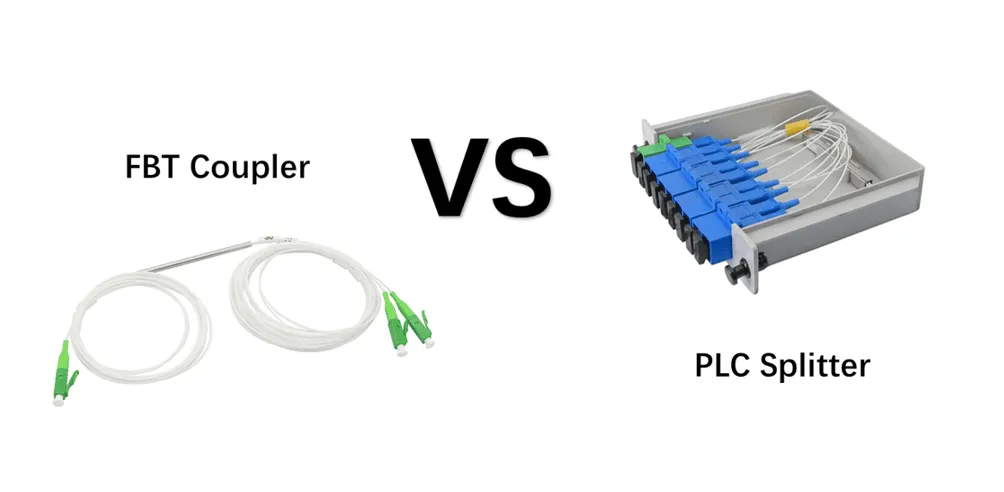
Fiber optic splitters distribute optical signals across networks. FBT (Fused Biconical Taper) splitters fuse and stretch fibers to split light. PLC (Planar Lightwave Circuit) splitters use silica chips with etched waveguides. The choice impacts cost, scalability, and reliability. Industry reports confirm PLC adoption now exceeds 75% in new deployments due to higher port density.
Fundamental Working Principles
FBT Splitter Construction:
Two or more fibers fused and tapered manually
Signal splits via coupling in the fused zone
Inconsistent splitting ratios (e.g., 70:30)
PLC Splitter Construction:
Waveguides lithographically etched onto a silica chip
Light splits equally through Y-branches
Precision splitting (e.g., 50:50 in 1x2)
Structural differences affect size: FBT units are 2–4 cm long; PLC chips fit in 1–2 cm modules.
Performance Metrics Comparison
| Parameter | FBT Splitter | PLC Splitter |
|---|---|---|
| Insertion Loss | Higher (e.g., +0.5 dB) | Lower (-0.5 dB) |
| Uniformity | ±7 dB variation | ±3 dB variation |
| Temp Range | -5°C to 75°C | -40°C to 85°C |
| Wavelength Support | Single window (e.g., 1310nm) | Full spectrum (1260–1650nm) |
Manufacturing & Cost Analysis
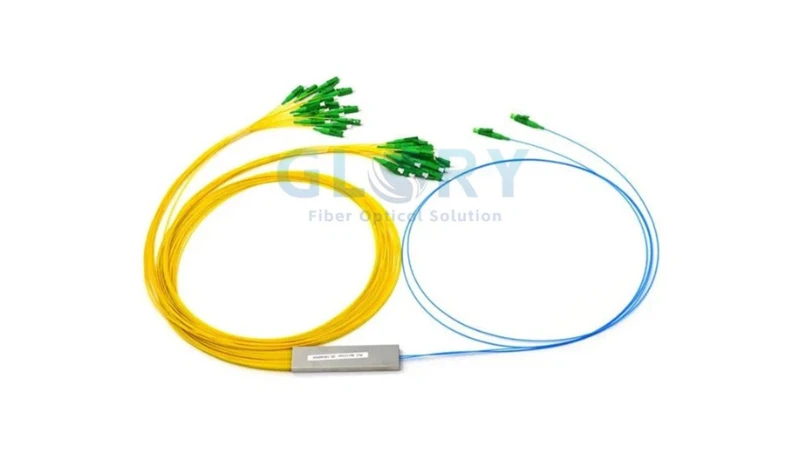
FBT Production:
Labor-intensive: Technicians fuse/taper fibers (1–2 hours/unit)
Low material cost; high scrap rates
Economical below 1x8 splits ($15/port)
PLC Production:
Automated wafer processing (100+ chips/batch)
High initial lithography costs; cheaper at scale
Cost-effective beyond 1x16 ($40 for 1x32 vs. FBT's $65)
Optcore 2023 data shows PLC costs drop 60% at 1k-unit orders.
Application-Specific Suitability
Choose FBT When:
Deploying in rural/low-density FTTH
Needing asymmetric splits (e.g., CATV)
Operating in stable, room-temperature environments
Choose PLC When:
Building high-density data centers/GPON
Requiring >1x16 splits in compact modules
Facing extreme temperatures (e.g., desert enclosures)
Cablestogo field studies show 34% lower PLC failure rates in harsh climates.
Selection Guidelines
Consider these factors:
Port Count: FBT for ≤1x8; PLC for ≥1x16
Environment: PLC for <-10°C or >75°C; FBT for controlled settings
Budget: FBT under $20/split; PLC for scalable projects
Signal Sensitivity: PLC for critical low-loss/high-uniformity apps
Avoid mixing types in cascaded networks-insertion loss inconsistencies cause signal degradation.
Future Evolution & Hybrid Solutions
Multicore PLC: Enables 1x128 splits in standard chip sizes
Automated FBT: Robotics cutting production costs by 30%
Hybrid Designs: FBT for trunk lines + PLC for distribution
Market analysts project PLC will dominate 90% of splitters by 2028, with FBT reserved for niche asymmetric needs.