





Comparative Analysis of CWDM and DWDM Technologies
 Dec 01, 2025|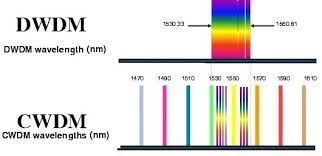
Wavelength Division Multiplexing (WDM) technology is an economical solution that effectively increases the capacity of existing optical fiber networks without increasing the physical optical fiber layout. In this technical system, coarse wavelength division multiplexing (CWDM) and dense wavelength division multiplexing (DWDM) are two main implementation methods, and there are significant differences between them in terms of channel spacing, technical performance, cost composition and application fields.
I. Technical Characteristics of CWDM (Coarse Wavelength Division Multiplexing)
The "thick" character in CWDM is mainly reflected in its channel spacing. This technology employs a wide channel interval of up to 20 nanometers, and its standardized channels typically cover a spectral range from 1270 nanometers to 1610 nanometers, totaling 18 wavelength channels. In actual system deployment, eight channels located in the upper band ranging from 1470 nanometers to 1610 nanometers are commonly adopted.
Although they are often simply referred to as 1470 nanometers, 1490 nanometers, etc. in business, the precise wavelength values defined by the International Telecommunication Union (ITU) standards are 1471 nanometers, 1491 nanometers, 1511 nanometers, etc. The channel of CWDM covers multiple bands such as O, E, S, C and L of single-mode optical fiber systems. Among them, the 1550-nanometer band is more commonly used due to its lower optical fiber transmission loss.
Wide channel spacing is a core feature of CWDM technology, which simplifies the optical structure of its multiplexers/splitters. For instance, the number of coating layers required for filter plates is reduced, thereby enhancing production yield and significantly lowering overall costs. However, this wide interval also limits the number of channels it can support on a single optical fiber (typically up to 18), and it is difficult to work in coordination with optical amplifiers that require specific wavelength intervals.
II. Technical Characteristics of DWDM (Dense Wavelength Division Multiplexing)
In sharp contrast to CWDM, DWDM pursues extremely high spectral utilization density. Its channel spacing is very narrow, typically 0.4 nanometers (50GHz), 0.8 nanometers (100GHz), or 1.6 nanometers (200GHz). The working band of DWDM is mainly concentrated in the C band (1525 nanometers to 1565 nanometers), and is expanding towards the L band (1570 nanometers to 1610 nanometers).
With its dense channel distribution, DWDM systems can carry 40, 80, 96 or even up to 160 independent wavelength channels on a single optical fiber. More importantly, its tight wavelength intervals enable it to be perfectly compatible with optical amplification devices such as erbium-doped fiber amplifiers (EDFA), thereby overcoming the limitation of fiber attenuation on transmission distance and achieving ultra-long-distance signal transmission.
III. Comparison of Application Scenarios between CWDM and DWDM
|
Characteristic |
CWDM (Coarse Wavelength Division Multiplexing) |
DWDM (Dense Wavelength Division Multiplexing) |
|---|---|---|
|
Channel Spacing |
Wide (20 nm) |
Narrow (e.g., 0.4nm, 0.8nm, 1.6nm) |
|
Wavelength Range |
Broad (1270nm-1610nm); Commonly used: 1470nm-1610nm |
Narrow (Primarily C-band: 1525nm-1565nm; Extendable to L-band) |
|
Number of Channels |
Few (Up to 18) |
Many (Up to 40, 80, 160 or more) |
|
Transmission Distance |
Short (Typically ≤ 80 km) |
Long (Capable of hundreds to thousands of km) |
|
Key Capability |
Does not support optical amplification |
Supports optical amplification (enabling distance extension via repeaters) |
|
Cost |
Lower (Simpler components, reduced cost) |
Higher (More complex technology) |
|
Application Scenarios |
Cost-sensitive, short-reach, lower-capacity (<10G) scenarios; e.g., metro access layer, enterprise/campus networks. |
High-capacity, long-haul backbone networks; e.g., long-distance trunk lines, high-capacity metro core networks. |
Core Differences Comparison: CWDM vs. DWDM
The differences in technical characteristics directly determine their distinct application positioning:
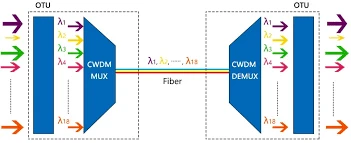
CWDM, with its cost advantage, is mainly applied in scenarios where the transmission capacity requirement is relatively low (usually below 10Gbps), the transmission distance is short (generally no more than 80 kilometers), and the cost factor is crucial. Typical applications include the metropolitan area network access layer, enterprise networks, campus networks, etc.
DWDM, on the other hand, focuses on addressing the transmission demands of large capacity and long distances. It can carry massive amounts of data and support ultra-long-distance transmission over hundreds to thousands of kilometers, thus becoming an ideal choice for scenarios such as long-distance trunk networks and the core layer of ultra-high-capacity metropolitan area networks.
Conclusion
To sum up, CWDM and DWDM are two major branches of WDM technology catering to different demands. CWDM is renowned for its economy and practicality, and is suitable for short-distance and low-cost construction requirements. DWDM, with high capacity and long distance as its core competitiveness, is a cornerstone technology for building modern information and communication backbone networks. In actual network planning, the appropriate technical solution should be selected based on specific capacity, distance and budget constraints.