





Analysis of Optical Fiber Modes in Communication Systems
 Nov 14, 2025|
 In the field of optical fiber communication, "Mode" is a fundamental concept that determines the transmission characteristics of optical signals and ultimately influences the performance of the entire communication system. Below is a detailed analysis of fiber modes.
1. Basic Definition of Modes
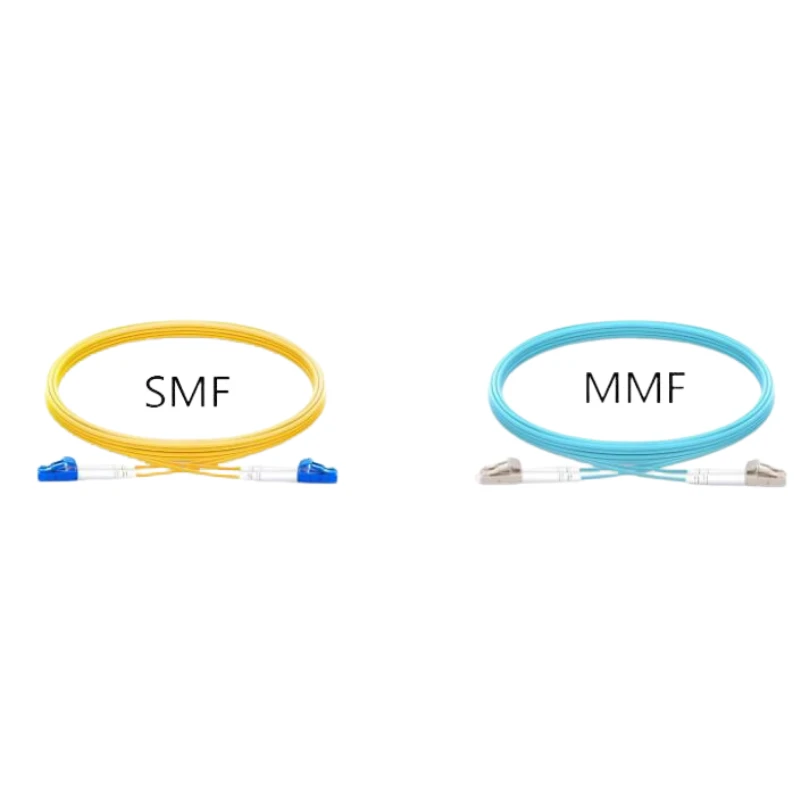
In optical fibers, a "mode" refers to a specific spatial distribution or path that light waves follow as they propagate through the fiber core.
Each mode corresponds to a unique electromagnetic field distribution pattern, which is determined by the fiber's structure and boundary conditions.
Modes can be understood as discrete "channels" through which light is guided via reflections and propagation within the core. From the perspective of electromagnetic theory, a mode is a solution to Maxwell's equations under specific boundary conditions.
The electric field distribution of a mode can be expressed as Eβ(x,y,z,t)=Eβ(x,y)ei(ωt−βz), where Eβ(x,y)is the transverse field distribution, and βis the propagation constant.
2. Single-Mode Fiber vs. Multi-Mode Fiber
Based on the number of supported modes, optical fibers are mainly categorized into Single-Mode Fibers (SMF) and Multi-Mode Fibers (MMF), which differ significantly in structure and characteristics:
|
Property |
Single-Mode Fiber (SMF) |
Multi-Mode Fiber (MMF) |
|---|---|---|
|
Core Diameter |
Small (typically 8–10 μm) |
Large (typically 50 or 62.5 μm) |
|
Number of Modes |
Supports only one mode (fundamental mode) |
Supports hundreds of modes |
|
Light Source |
Lasers (producing near-single-mode light) |
LEDs or low-cost lasers (more scattered light) |
|
Dispersion |
Negligible modal dispersion; material and waveguide dispersion present |
Significant modal dispersion, causing pulse broadening |
|
Bandwidth & Distance |
High bandwidth, suitable for long-distance transmission (up to tens of kilometers) |
Lower bandwidth, suitable for short-distance transmission (typically < 2 km) |
|
Cost |
Higher fiber and laser cost |
Lower fiber cost, more economical connectors and sources |
|
Typical Applications |
Telecom backbone, long-distance communication, submarine cables |
Local Area Networks (LAN), data centers, building cabling |
The small core diameter of SMF allows only the fundamental mode to propagate along the fiber axis, nearly eliminating modal dispersion. This enables signals to travel longer distances with minimal distortion. In contrast, the larger core of MMF permits multiple modes to propagate simultaneously. However, the different path lengths of these modes lead to modal dispersion, which broadens signal pulses and limits bandwidth and transmission distance.
3. How Modes Work
Optical fibers confine light within the core through the principle of total internal reflection. When light traveling in the high-refractive-index core hits the interface with the lower-index cladding at an angle greater than the critical angle, it is entirely reflected back into the core.
In SMF, light propagates almost in a straight line, following a single path.
In MMF, light reflects at different angles, forming multiple paths (e.g., low-order modes reflect less frequently, while high-order modes reflect more often). The differences in path lengths cause variations in the arrival time of light pulses, resulting in modal dispersion.
Advanced mode control techniques, such as those based on Fractional Fourier Transform, allow spatial and phase modulation of mode coupling states, enabling effective mode decomposition and analysis of higher-order modes.
4. Impact of Modes on System Performance
Bandwidth and Distance: SMF offers higher bandwidth and is suited for long-distance communication due to negligible modal dispersion. MMF, limited by modal dispersion, provides lower bandwidth and is generally used for short-distance links.
Signal Quality: Modal dispersion can cause pulse overlapping and increase bit error rates. SMF generally offers superior signal quality; MMF often requires graded-index designs or mode compensation techniques to mitigate dispersion.
Cost Considerations: MMF systems (light sources, connectors) are less expensive and ideal for short-reach applications. Although SMF components cost more, they are more suitable for high-speed, long-haul transmission in the long run.
Emerging fiber designs and mode monitoring techniques, such as all-fiber mode monitors based on Mach-Zehnder interferometers, help manage mode-dependent losses (MDL) and improve signal integrity in advanced systems.
5. Application Scenarios
Single-Mode Fiber: Primarily used in telecom backbone networks, long-distance links (e.g., city-to-city connections), submarine cables, and other high-bandwidth, low-loss scenarios.
Multi-Mode Fiber: Common in data centers, enterprise LANs, campus networks, and other short-distance, high-bandwidth environments.
6. Future Trends
To increase fiber capacity, researchers are developing few-mode fibersand space-division multiplexing (SDM)technologies, which transmit multiple independent modes simultaneously within a single fiber. These approaches precisely control mode characteristics to enhance bandwidth without significantly increasing dispersion. For instance, coupled multi-core fibers (CC-MCF) and advanced mode management techniques show promise for next-generation transoceanic cables and high-spatial-density communication systems.
Summary
Understanding optical fiber modes is essential for designing efficient optical communication systems. Single-mode fibers enable low-loss, high-bandwidth long-distance transmission through a single mode, while multi-mode fibers provide cost-effective solutions for short-reach applications. Future mode multiplexing technologies are expected to further push the limits of fiber capacity.
I hope this analysis helps you gain a comprehensive understanding of optical fiber modes and their applications. If you are interested in specific technical details, please feel free to reach out to us at any time. We look forward to fostering a long-term and mutually beneficial partnership with you.